Friday, September 4, 2009

Canada


British Columbia is Canada's westernmost province, along the Pacific Ocean. The winters in the coastal areas are relatively warm compared to the rest of Canada. British Columbia is broken into 6 regions:
Vancouver, Coast & Mountains
Thompson Okanagan
Cariboo Coast Chilcotin
Northern British Columbia
Kootenay Rockies
Vancouver Island
British Columbia (BC) is Canada's most mountainous province, boasting some of the most spectacular alpine scenery in the world. Not surprising then that alpine skiing is a major draw for the province. The province has about 33 large ski resorts spread out from Vancouver Island to the Alberta border. Whistler, British Columbia, nestled in the rugged Coast Mountains, is consistently ranked as the #1 ski resort destination in North America and will co-host the 2010 Winter Olympic Games.
Vancouver, the largest Canadian metropolitan area west of Toronto, is one of Canada's most multi-cultural cities, with a large proportion of people of Asian origin. Being a harbour city, Vancouver enjoys beautiful landscapes of mountains and ocean.
Sites of interest in Vancouver
Capilano Suspension Bridge, a 136m long bridge 70m above the Capilano River
Stanley Park, a large forested park near downtown, the largest city owned park in Canada. 8 million visitors each year.
Granville Island, a small island near downtown with a public market, marina, shopping and theaters.
Chinatown, Vancouver, one of the largest in North America.
Robson Street, a bustling upscale shopping district with a good selection of restaurants.
Gastown, a mix of tourist-oriented businesses, restaurants and nightclubs.
Vancouver Art Gallery
Vancouver Maritime Museum
Museum of Anthropology at UBC
Vancouver Museum
Science World at Telus World of Science
Vancouver is home to the
BC Lions, Canadian Football League
Vancouver Canucks, National Hockey League
Victoria, British Columbia, located on scenic Vancouver Island, is a major Canadian tourist destination attracting millions of visitors each year. Popular actives for tourists are whale watching, enjoying the busking in the inner harbour area and visiting world famous Butchart Gardens.
Long Beach(Pacific Rim National Park) and the communities of Tofino and Ucluelet are popular tourist areas. Tofino, a town with a population of only a few thousand hosts more than one million visitors each year. Many new resorts are being built in this area to accommodate the surfers, beach lovers, storm watchers and golfers.
Whale watching is common along the coastal areas of BC as is Pacific storm watching along the west coast of Vancouver Island during the winter months.
Wine tours are common in the Okanagan Valley, BC's wine and orchard country. The Okanagan valley area boasts some of the best beaches and warmest summer temperatures in Canada, as well as Canada's only hot desert around the town of Osoyoos. There are 53 golf courses and two major ski resorts in the valley.
British Columbia is also a popular location for the production of many Hollywood films, it is the third largest film center in North America behind California and New York.

India


Tourism is the largest service industry in India, with a contribution of 6.23% to the national GDP and 8.78% of the total employment in India. India witnesses more than 5 million annual foreign tourist arrivals and 527 million domestic tourism visits The tourism industry in India generated about US$100 billion in 2008 and that is expected to increase to US$275.5 billion by 2018 at a 9.4% annual growth rate. The Ministry of Tourism is the nodal agency for the development and promotion of Tourism in India. It maintains the Incredible India campaign.
According to World Travel and Tourism Council, India will be the world's leading tourism hotspot, having the highest 10-year growth potential. The Travel & Tourism Competitiveness Report 2007 ranked tourism in India 6th in terms of price competitiveness and 39th in terms of safety and security.
However, India's tourism sector currently lags behind less endowed countries and faces serious challenges including shortage of hotel rooms. In 2007, there were only 25,000 tourist-class hotel rooms in the whole of India. Among other factors hindering the growth of the tourism industry in India are stringent visa requirements and congested airports. Despite short- and medium-term setbacks, tourism revenues are expected to surge by 42% from 2007 to 2017.
India has a growing medical tourism sector. The 2010 Commonwealth Games in Delhi are expected to significantly boost tourism in India.

China


Tourism in China has greatly expanded over the last few decades. The emergence of a newly rich middle class and an easing of restrictions on movement by the Chinese authorities are both fueling this travel boom. China has become one of the world's most-watched and hottest outbound tourist markets. The world is on the cusp of a sustained Chinese outbound tourism boom.
China is the world's fourth largest country for inbound tourism. The number of overseas tourists was 55 million in 2007. Foreign exchange income was 41.9 billion U.S. dollars, the world's fifth largest in 2007. The number of domestic tourists totaled 1.61 billion, with a total income of 777.1 billion yuan.
According to the WTO, in 2020, China will become the largest tourist country and the fourth largest for overseas travel. In terms of total outbound travel spending, China is currently ranked fifth and is expected to be the fastest growing in the world from 2006 to 2015, jumping into the number two slot for total travel spending by 2015.

Singapore


The board was first established in 1964 and was called the Singapore Tourist Promotion Board. In that year, there were 91,000 visitors. The primary task of STPB was to coordinate the efforts of hotels, airlines and travel agents to develop the fledging tourism industry of the country.
Later, STPB began to initiate new marketing ideas to promote Singapore's image aboard. The board created the Merlion, a symbol based on a Singapore mythical legend, that became an icon of the Singapore destination. The board also has been providing travel agent licensing and tourist guide training.
STPB actively promotes the development of infrastructure, including the building of hotels and tourist attractions such as the Jurong Bird Park and Sentosa which now becomes a popupar resort island for both tourists and local visitors. The board also market the city as a convention venue and organised events to attract visitors.
In the 1980s, several historic and cultural significant areas such as the Chinatown, Little India and Arab Street were earmarked for preservation. These places express Singapore's cultural diversity and became popular tourist destinations. The Singapore River underwent a major cleanup program and the areas along the river were developed for restaurants and other tourists amenities.
The board was renamed as Singapore Tourism Board in 1997. The board now oversees all aspects of tourism, including resource allocation and long-term strategic planning. It establishes offices around the globe to actively market the Singapore destination.
Singapore tourism industry has grown rapidly since STPB was set up. In 2004, there were 8 million visitors. On 11 January 2005, Minister for Trade and Industry unveiled the Singapore Tourism Board’s (STB) bold targets to doubling visitor arrivals to 17 million by 2015, see details here Tourism 2015.

Bhutan


Tourism in Bhutan began in 1974, when the Government of Bhutan, in an effort to raise revenue and to promote the country's unique culture and traditions to the outside world, opened its isolated country to foreigners. In 1974, 287 tourists visited Bhutan. Since then the number of tourists visiting Bhutan has increased to 2,850 in 1992, rising dramatically to 7,158 in 1999. By the late 1980's tourism contributed over US$2 million in annual revenue.
Despite being open to foreigners, the government is acutely aware of the environmental impact tourists can have on Bhutan's unique and virtually unspoiled landscape and culture. Therefore, they have restricted the level of tourist activity from the start, preferring higher quality tourism. Until 1991, the Bhutan Tourism Corporation (BTC), a quasi-autonomous and self-financing body, implemented the government's tourism policy. The Bhutanese government, however, privatised the Corporation in October 1991, facilitating private sector investment and activity. As a result, today over 75 licensed tourist companies operate in the country.
The most important centres for tourism are in Bhutan's capital Thimphu, and in the western city of Paro, near India. Taktshang, a cliff side monastery overlooking the Paro Valley, is one of the country's attractions. Druk Air is currently the only airline operating flights in Bhutan.

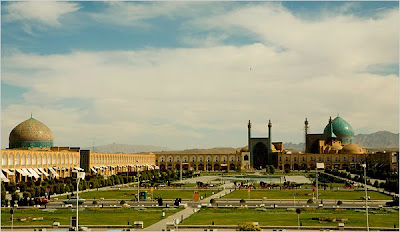
Iran


Tourism in Iran before the accession of the theocracy, was characterized by a significant numbers of visitors travelling to Iran for its diverse attractions, boasting cultural splendours and a diverse and beautiful landscape suitable for a range of activities. Tourism declined dramatically during the Iran–Iraq War in the 1980s but has subsequently revived.
The landscape of Iran is diverse and beautiful, providing a range of activities from hiking and skiing in the Alborz mountains, to beach holidays by the Persian Gulf and the Caspian Sea. Over the next five years a number of tourism-friendly infrastructure projects will be undertaken on the Gulf island of Kish, which at present attracts around 1m visitors per year, the majority of whom are Iranian.
Since the Iranian revolution in 1979, the majority of visitors to Iran have been religious pilgrims and businesspeople. Official figures do not distinguish between those travelling to Iran for business and those coming for pleasure, and they also include a large number of diaspora Iranians returning to visit their families in Iran or making pilgrimages to holy Shia sites near Mashhad and elsewhere. Despite the international tensions, the government continues to project strong rises in visitor numbers and tourism revenue over the forecast period, and to talk of projects to build an additional 100 hotels, for example, to expand its currently limited stock.

New york


Tourism in New York City includes nearly 47 million foreign and American tourists each year. Major destinations include the Empire State Building, Ellis Island, Broadway theatre productions, museums such as the Metropolitan Museum of Art, and other tourist attractions including Central Park, Washington Square Park, Rockefeller Center, Times Square, the Bronx Zoo, Chelsea Piers, New York Botanical Garden, luxury shopping along Fifth and Madison Avenues, and events such as the Halloween Parade in Greenwich Village, the Tribeca Film Festival, and free performances in Central Park at Summerstage and Delacorte Theater. The Statue of Liberty is a major tourist attraction and one of the most recognizable icons of the United States. Many New York City ethnic enclaves, such as Jackson Heights, Flushing, and Brighton Beach are major shopping destinations for first and second generation Americans up and down the East Coast.
New York City has over 28,000 acres (110 km2) of parkland and 14 linear miles (22 km) of public beaches. Manhattan's Central Park, designed by Frederick Law Olmsted and Calvert Vaux, is the most visited city park in the United States. Prospect Park in Brooklyn, also designed by Olmsted and Vaux, has a 90 acres (36 ha) meadow. Flushing Meadows-Corona Park in Queens, the city's third largest, was the setting for the 1939 World's Fair and 1964 World's Fair.
New York's food culture, influenced by the city's immigrants and large number of dining patrons, is diverse. Jewish and Italian immigrants made the city famous for bagels, cheesecake and New York-style pizza. Some 4,000 mobile food vendors licensed by the city, many immigrant-owned, have made Middle Eastern foods such as falafels and kebabs standbys of contemporary New York street food. The city is also home to many of the finest haute cuisine restaurants in the United States.

The famed Dakota on Central Park West

View from Central Park of buildings along Central Park South, including Essex House
Sporting events are also tourist events. Major venues include Yankee Stadium, Citi Field, and Madison Square Garden, and street events such as the New York Marathon also attract tourists.
Tourism in New York City is a large industry. According to NYC & Company, the top producing countries for international visitors to New York City in 2005 were the United Kingdom (1,169,000), Canada (815,000), Germany (401,000), Japan (299,000), Italy (292,000), France (268,000), Ireland (253,000), Australia (235,000), Spain (205,000), and the Netherlands (147,000).
Spearheading the city's tourism efforts is NYC & Company, the city's official convention and visitor bureau currently headed by George Fertitta. It has offices in 14 countries, including Argentina, Britain, France, Germany, Ireland, Italy, Mexico, The Netherlands, Russia, Spain, Sweden, Japan, Korea and China. NYC & Company is the official source of tourism statistics for the city. The research department develops and distributes comprehensive information on NYC domestic and international visitor statistics and monitors the travel industry's impact on New York City's economy. The department also produces 14 official New York City tourism marketing publications that feature information on member hotels, museums, attractions, theaters, stores, restaurants, meeting venues, and service providers.
Double decker tour buses and boats with tour guides bring sightseers to various parts of Manhattan and other boroughs, while pedicabs and horse cabs serve those with a taste for more personal service. More adventurous tourists rent bicycles at neighborhood shops or along the Hudson River Greenway or simply walk, which is often the quickest way to get around in congested, busy commercial districts and always the best way to appreciate street life.
Many visitors investigate their genealogy at historic immigration sites such as Ellis Island and the Statue of Liberty. Other tourist destinations include the Empire State Building, for 41 years the world's tallest building after its construction in 1931, Radio City Music Hall, home of The Rockettes, a variety of Broadway shows, the Intrepid Sea-Air-Space Museum, housed on a World War II aircraft carrier, and city landmarks such as Central Park, which is one of the finest examples of landscape architecture in the world. New York City has encouraged tourist shopping by eliminating its sales tax on clothing and footwear.
The World Trade Center was an important tourist destination before the September 11, 2001 attacks, which devastated the city and its tourist industry. The city was nearly devoid of tourists for months,[dubious – discuss][citation needed] and it took two years for the numbers to fully rebound with fewer international, but more domestic visitors. Now the World Trade Center site has itself become an important place for visitors to see.